I was lucky enough to have a table at the Leith Witchcraft Market for Samhain. It was a totally new experience for me. I’ve traded at markets before, selling my own art and for other people but I’ve never done readings at an event like this. (This post has taken me so long to write that you can find me again at the market for Yule on the 10th December!)
I performed over forty readings on this day and while it felt a bit white-knuckle at points, I loved every second of it. I had thought I might have time to jot down the cards that were coming up, as journaling is a key part of my tarot practice, but that quickly fell by the wayside. Despite this, it was interesting to notice which cards came up often enough to make an impression amongst the sea of cards.
The cards I noticed cropping up time and time again were the three of swords, the four of swords and the wheel of fortune. Today I want to talk about my experience with the three and four of swords.
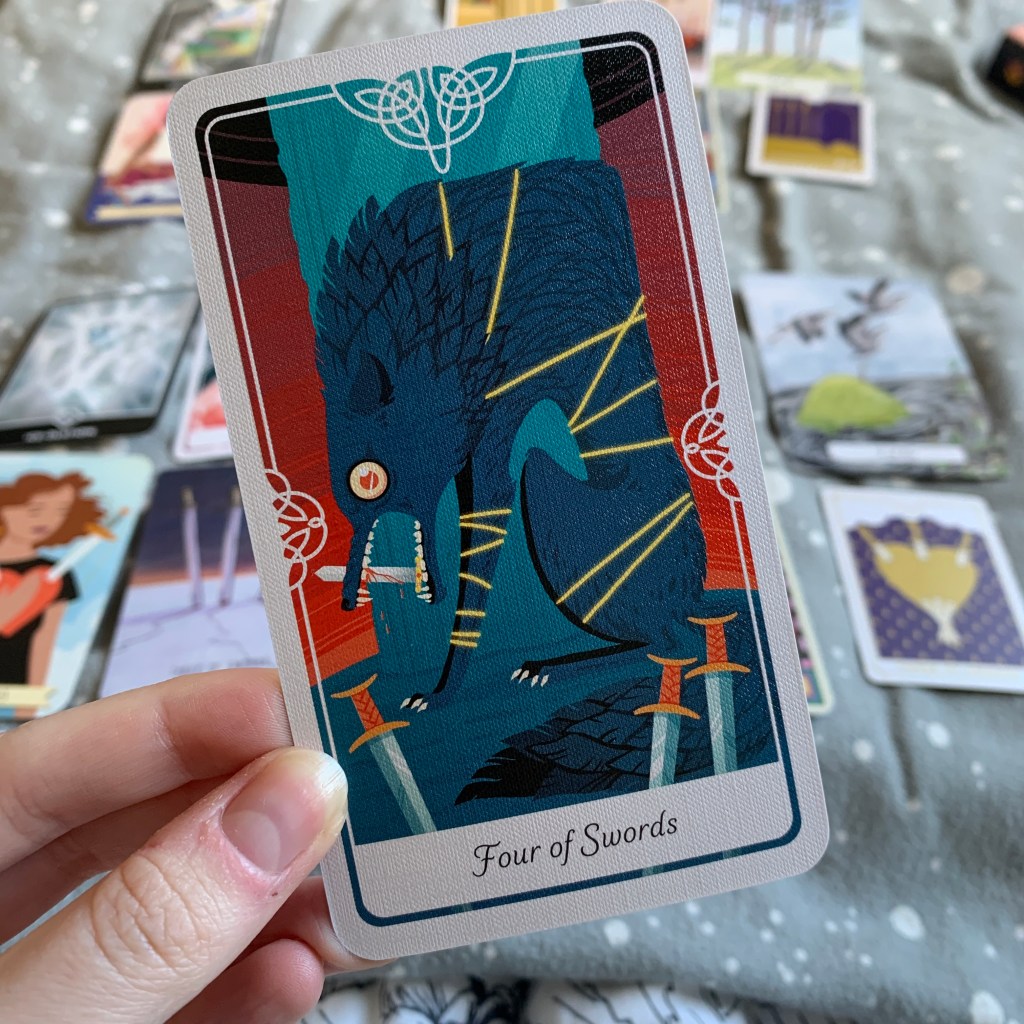
I was using the Tarot of the Divine by Yoshi Yoshitani (I recently shared a little review) – this is a deck based around folklore and fairy tales from around the world and is a beautiful deck, full of diverse and gorgeous imagery. Each card in the deck is assigned a particular story, all of which are told very briefly in the book Beneath the Moon. The story assigned to the Three of Swords is the Crane Wife of Japanese folklore and the Four of Swords is Fenrir of Norse Mythology.
The depictions of these cards in these decks are notably different to classic RWS depictions, so different in fact that even though I had been dealing out the Three of Swords all day, it wasn’t until a querent mentioned how often they get the Three of Swords – both when they read for themselves and when done professionally – that it dawned on me what the card usually looks like.
It was in this moment that I realised that my choice of deck had done me real favours. Although I work hard to not sugar coat my readings, there is a particularly catastrophic feeling associated with the three of swords and using a deck with different imagery gave me the opportunity to discuss feelings of self sacrifice, grief and heartbreak without the querent getting the shock of the classic card.
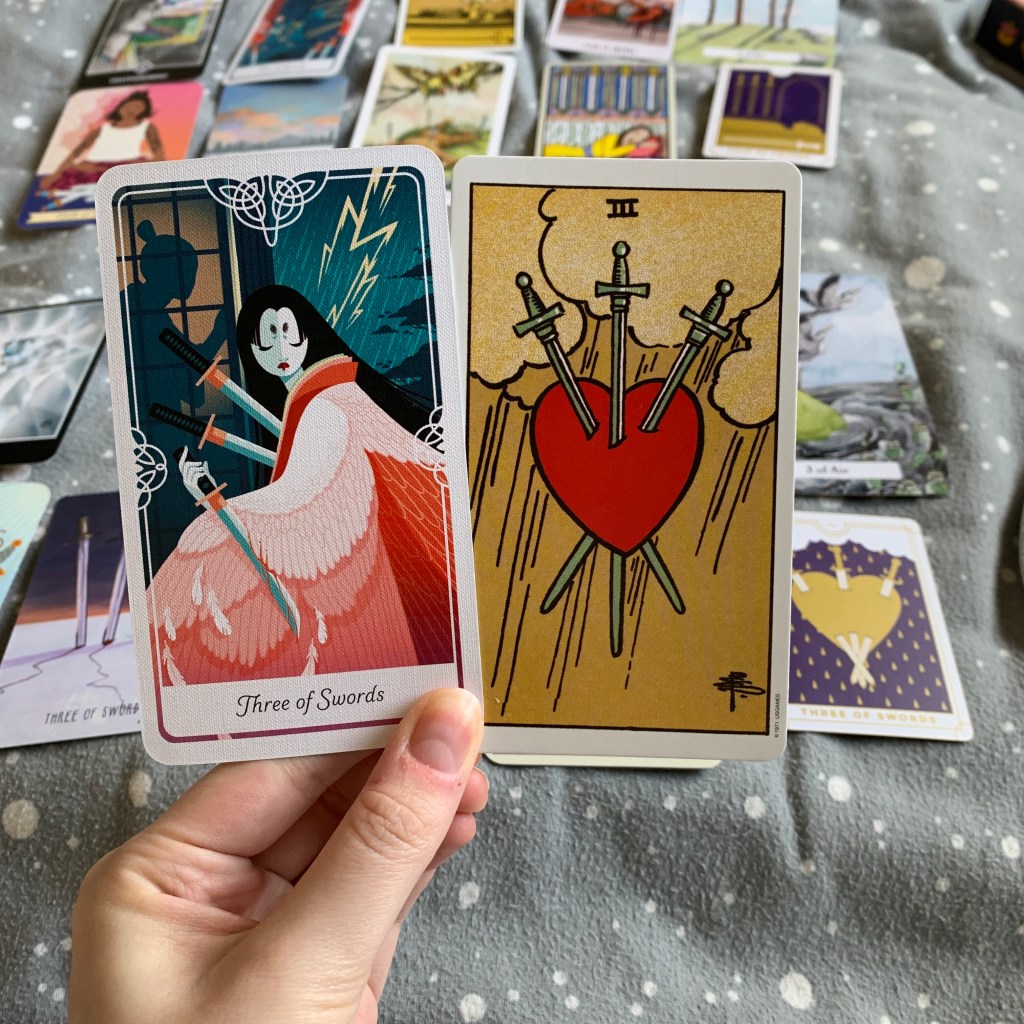
Conversely, the way the Four of Swords is depicted is miles away from my usual associations with the card. Usually, to me at least, this is a card showing a period of respite, a break between battles, a moment for peace and healing. However, in this deck we see Fenrir the giant wolf, foaming and bleeding at the mouth. His “rest” is enforced and it looks painful, he may be still but he’s fighting against it, which is totally different to my usual interpretation of the card, and took quite a bit of explaining when it cropped up in readings!
So I thought it would be interesting to pull out all my decks and take a look at these two cards in each deck. All of my decks follow the RWS system more or less, so they share plenty of common motifs but it has been fascinating to look at the different impressions each card gives, whether they feel positive, negative or neutral, whether they elicit a particular emotional response, and whether they feel in line with the general agreed meanings.
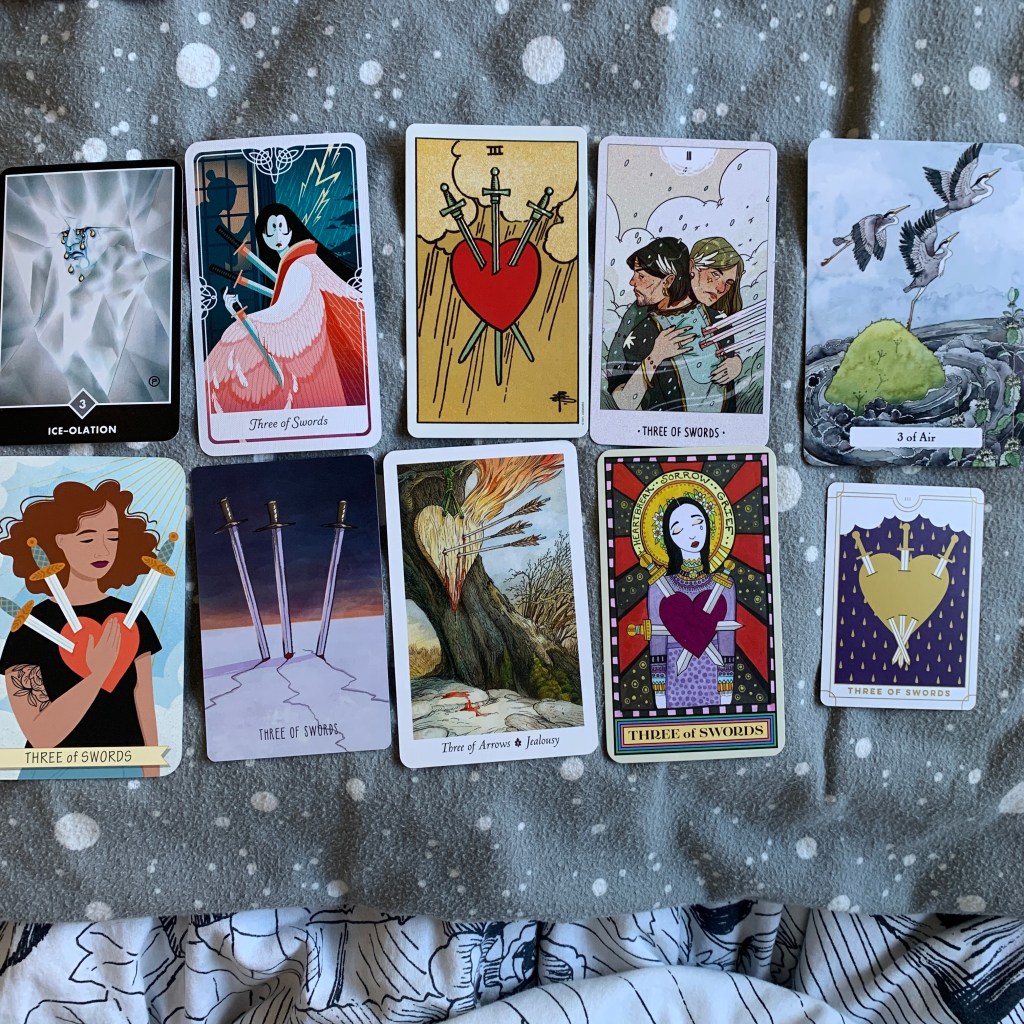
To start, let’s look at the three of swords. Usually depicted without any people on the card (unusual for the RWS deck), it shows the very dramatic image of three swords piercing a heart. Usually associated with heartbreak (a bit on the nose) and betrayal, it’s a pretty catastrophic looking card.
Whenever I pull the three of swords I’m always reminded of how it looks in the Fat Folks Tarot, a deck I don’t own (yet, fingers crossed for the second printing next year) but have had used in a wonderful reading/ coaching session with a TABI peer Alison from Tarot To Heal The World.

While the card still features the classic depiction of the thrice pierced heart – this time more anatomical – there is a lightness, a sense of gentle surrender rather than outright catastrophe. The card feels more in tune with the airy quality of the suit of swords, somehow more thoughtful than dramatic.
Amongst my decks the three of swords has a clear meaning, but within that there is a spectrum of feeling associated with it. There is variation around how dramatic the card feels, and also how lonely. The Osho Zen interpretation goes so far as to name the card “Ice-olation”, where the White Numen shows the betrayed character being caught by another.
The weather and temperature of the card changes too, many of the cards feature stormy weather, rain and ice but the Wildwood shows the heart on fire, honing in on the burning sensation that can come with jealousy rather than the frozen numbness of betrayal shown in the Spacious Tarot.
The three of swords in the Tarot of the Divine shows a winged woman slicing off her own feathers, the story goes that she is doing this for her family, her feathers can be used as raw materials and sold to make their fortune. The meaning here is clear to me, it’s a self sacrifice, possibly even self betrayal. Perhaps the shadowy figure in the background is making her do it but more than likely it is her own decision. Clipping her own wings for the sake of her family. So while the act is the same as the usual meaning of the card, the perpetrator is different, the call is coming from inside the house.
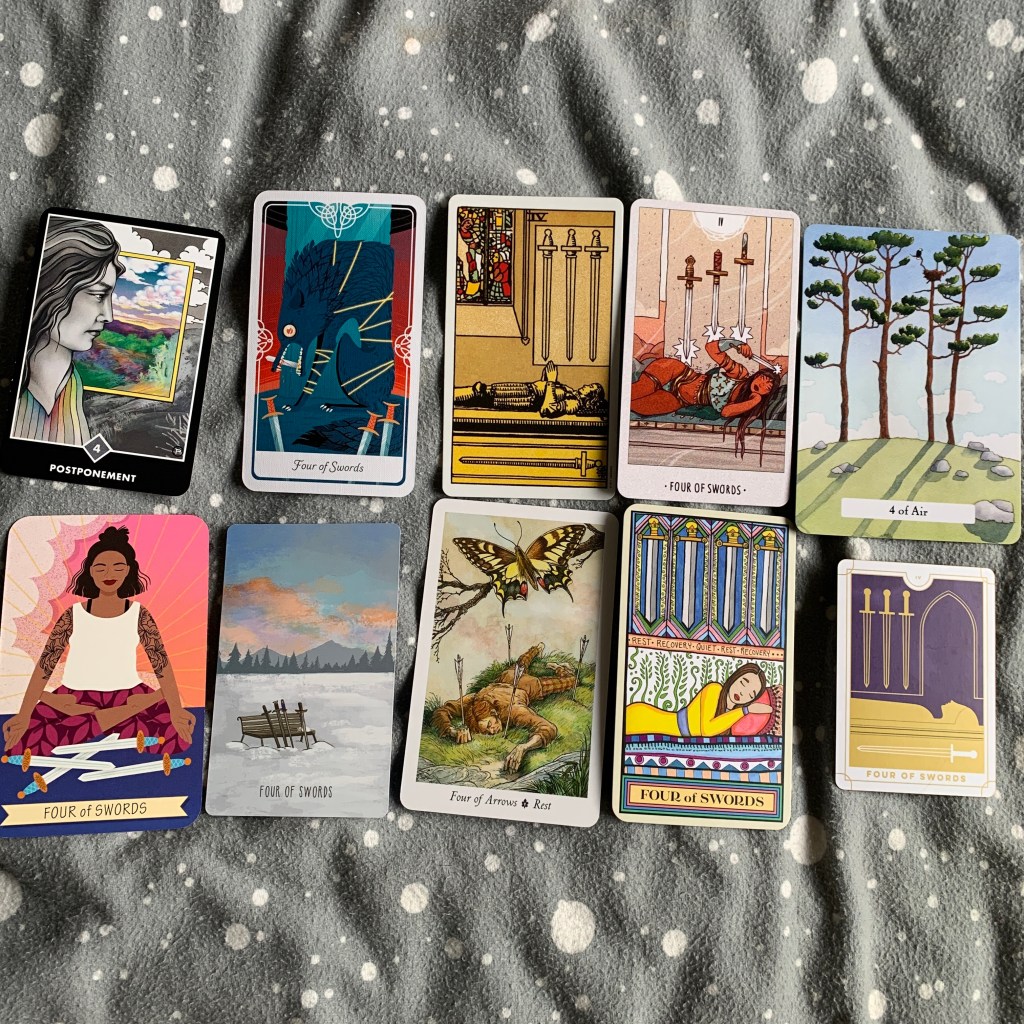
The four of swords seems to have one main difference between the depictions, who is enforcing this rest. Is it a peaceful meditative rest as seen in The Good Karma Tarot and the Wandering Star? Or is it brought about by being forced into submission by events outside your control as seen in the Wildwood and the Tarot of the Divine?
While fours in the tarot often provide a moment for stability and manifestation, all these cards hold slightly different energies. The classic meaning that has stuck with me has been the idea of the card showing a break between battles, a moment to lay down your sword, to rest and regroup. Each of the cards shows this to a greater or lesser extent but none so much as the Spacious Tarot, the swords leaning up against a lone bench in a serene but perhaps inhospitable landscape. The Osho Zen deck goes so far as to describe it as postponement with imagery to suggest waiting until the path ahead becomes clearer.
Fenrir, as shown in the Tarot of the Divine is bound into submission by an unbreakable, magical rope, he’s foaming at the mouth, thrashing against it and manages to bite off the arm of a god in the struggle. The story goes that when he finally breaks free of his bonds, the world will be plunged into Armageddon, Ragnarök. This is a much less cosy and comforting idea of rest than other depictions for sure.
However, despite the dramatic narrative at play in this card, I can still find a place for it. If we needed a card to symbolise burnout, this would be it. A card that shows that if we don’t take time to rest something is going to do it for us whether that be our own bodies or people in our lives. The card serves as a warning for what happens if we charge into things without considering our own capacity and well-being and I’m sure we can all relate to that.

 Sapling Tarot
Leave a reply to #31DaysOfTarot (Part One) – Sapling Tarot Cancel reply