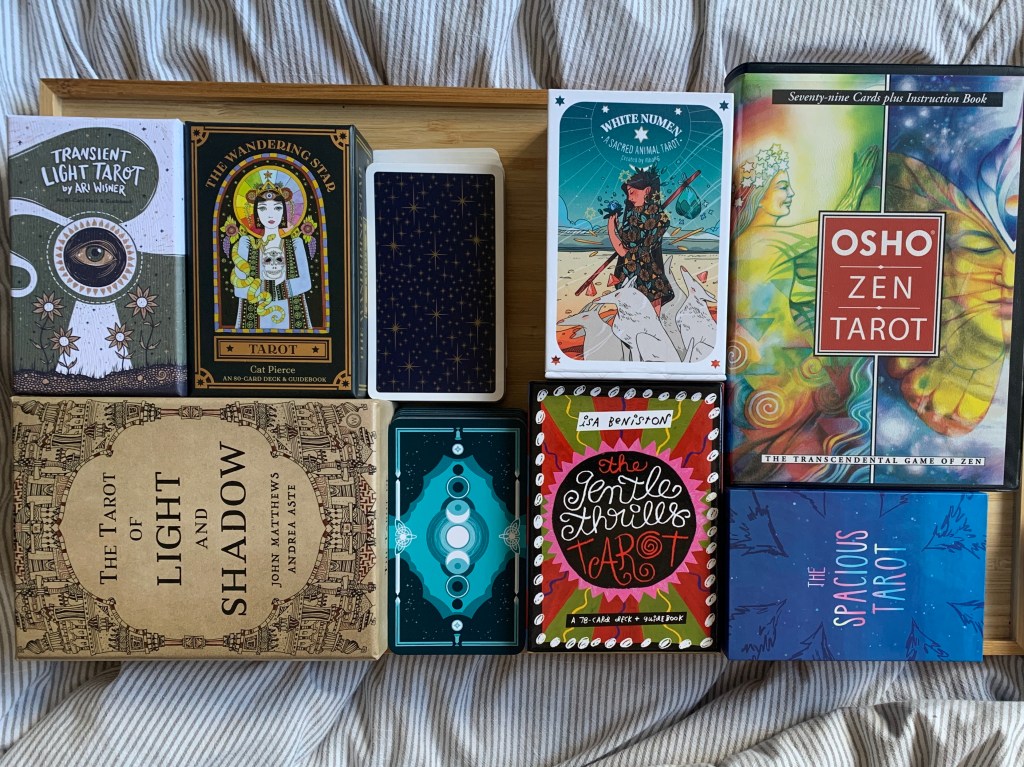
#30DaysOfTarot
I was recently absolutely thrilled when one of my fellow TABI members posted that they had been so inspired by the #31DaysOfTarot posts I wrote in January (which in turn were inspired by Ethony‘s challenge from previous years) that they had written their own series of prompts to work through this month – so of course I had to join in!
1. What is tarot to you?
Tarot, to me, has been a tool for developing my understanding of the human condition. Within the cards, you can find pretty much every event that might happen in someone’s life and every person you might meet along the way. Using the cards has helped me develop my own intuition but also has given me insight into the lives of others.
2. Draw a card, describe it as if you were explaining it to someone else.
I’m using the Universal Waite deck, it’s my personal favourite clone of the classic Rider Waite Smith illustrations and has the most recognisable imagery of the decks I own, but I will be ignoring any religious symbols.
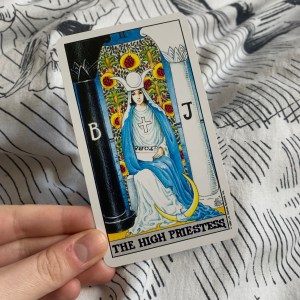
The card I’ve drawn is The High Priestess, card two in the Major Arcana. In the centre of the card sits the priestess, she has pale skin and dark hair beneath her white and blue robes. Her crown is pearly white and features a central orb reminiscent of a full moon. In her hands is a scroll and by her feet is a large crescent moon resting in the folds of her robes. The priestess sits on a stone slab between two pillars, one dark and one light, between them is a tapestry decorated with trees, leaves and pomegranates. Behind the tapestry is a still and peaceful sea.
3. Which card best represents who you’d like to be?
As I write this, I struggle to come up with a clear answer. I don’t know who I want to be, other than myself; because I feel this way, the card that feels most closely aligned with what I want right now is the Three of Wands.
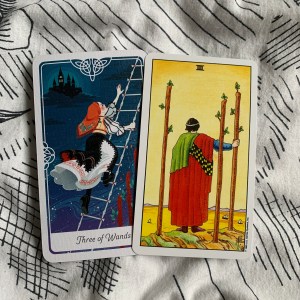
To me, the Three of Wands bursting with potential, it feels like the start of a journey, a journey for which you are totally prepared. The figures in the Three of Wands stands with so much purpose, they know what they want and how they’re going to get there – that’s what I could do with right now.
4. Look at the Death card. What does it mean to you?
For the first decade of my practice I used the Osho Zen tarot where the Death card is named Transformation, so it has never seemed like a scary card to me. Now that I’ve been reading professionally for a while, I’ve realised that I have the urge to explain away the intimidating nature of the Death card if it ever crops up in a reading. I’m working on not shying away from the traditional imagery and the feelings it might evoke in a querent.
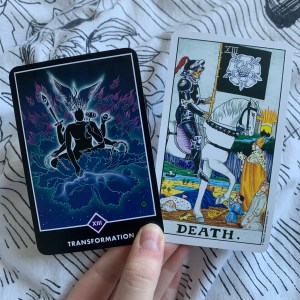
I love Pamela Coleman Smith’s original illustration, from the imposing figure of Death riding it’s pale horse, to the sun rising in the background between the two towers we see repeated through the Major Arcana. My favourite detail is the variety of people featured in the card, kings, priests and normal folk, Death stops for no one. There is an inevitability to the Death card (as there is to death itself), it is the great equaliser, you can’t bargain with it.
5. What would your perfect tarot deck look like?
I’ve really been struggling to think of an answer for this question. I like (and try to only acquire) decks that challenge me and expand my practice, as such it’s pretty difficult to imagine what the perfect deck would be because it probably would have to contain aspects that wouldn’t occur to me. I’m quite fussy with the decks I like, I generally like them fully illustrated and in colour but I don’t particularly respond to really cartoony or technicolour decks. I really value diversity and inclusivity but I don’t like it to feel like a box-ticking exercise. I like there to be layers to the cards but I struggle with designs that are too busy. I favour the RWS system but have no desire to collect exact clones. All that is to say, I’ll keep reviewing decks and if I come across my “perfect” one, you’ll be the first to know!
6a. Which is your favourite card in the suit of Wands?
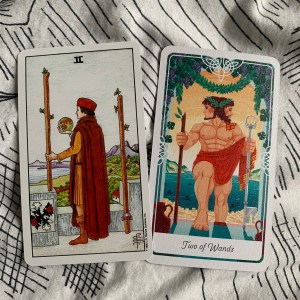
I think the Two of Wands might be my favourite? Although the Queen of Wands is also a card that pops up for me whenever I need her. The Two of Wands suggests options, paths we can take if we have the courage to make the first step. The card in the Tarot of the Divine shows the Roman god Janus, the god of beginnings and journeys (amongst other things). Janus is a god of transitions and to me that makes him a god of liminal spaces which are very important in my practice.
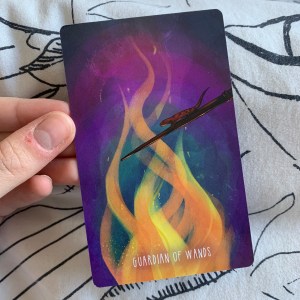
Recently I took a difficult trip to an event that caused me a lot of stress, before I left I pulled the Guardian (Queen) of Wands from the Spacious Tarot, it was exactly the card I needed in that moment and was my phone background for the trip. It felt like a gentler version of diamonds being made under great pressure, seeing the salamander surviving and thriving in amongst the beautiful rainbow flames, this card has become very important to me since then.
7. How would you describe your reading style?
I suppose the word that describes how I aspire to read is gentle. I want to create a space with my readings where people feel free the lean into their curiosity and explore their intuition. I believe in truth, but not harsh or brutal truth, I think that tarot readings create the opportunities to look at difficult situations from a place of slight detachment which can make room for different perspectives to appear.
 Sapling Tarot
Leave a comment