The Seed & Sickle Oracle Deck by Fez Inkwright, a UK based illustrator, was published by Liminal 11 in November 2021.
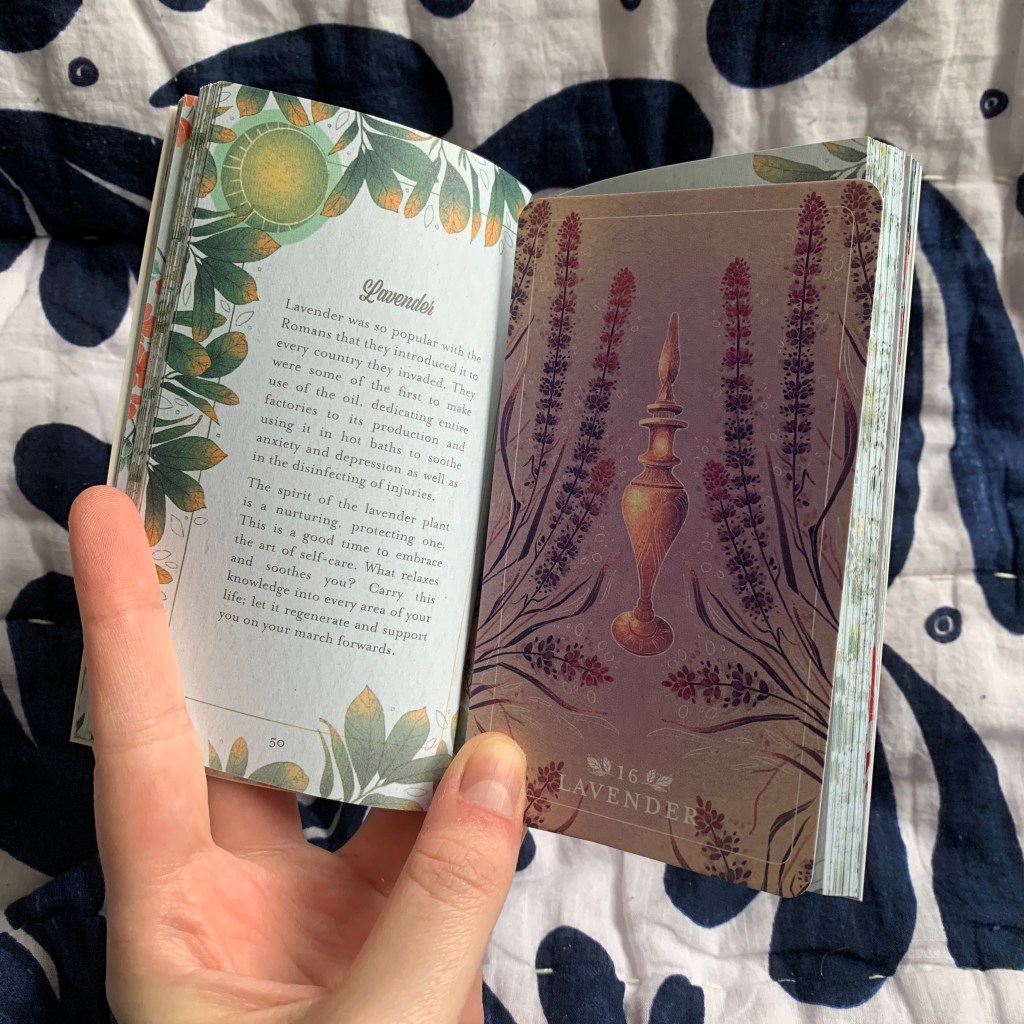
The deck comprises 55 cards featuring a variety of plants, most of which I think (but don’t quote me) are found in Britain and range from trees and herbs to weeds, poisonous plants and more. Two mini, 192 page, full colour, soft cover guidebooks accompany the deck, the Dawn guide for more motivational interpretations of the cards, and the Dusk guide for more reflective interpretations. The introduction to the guidebooks is written by Yoshi Yoshitani, of who you may already know that I am a huge fan.
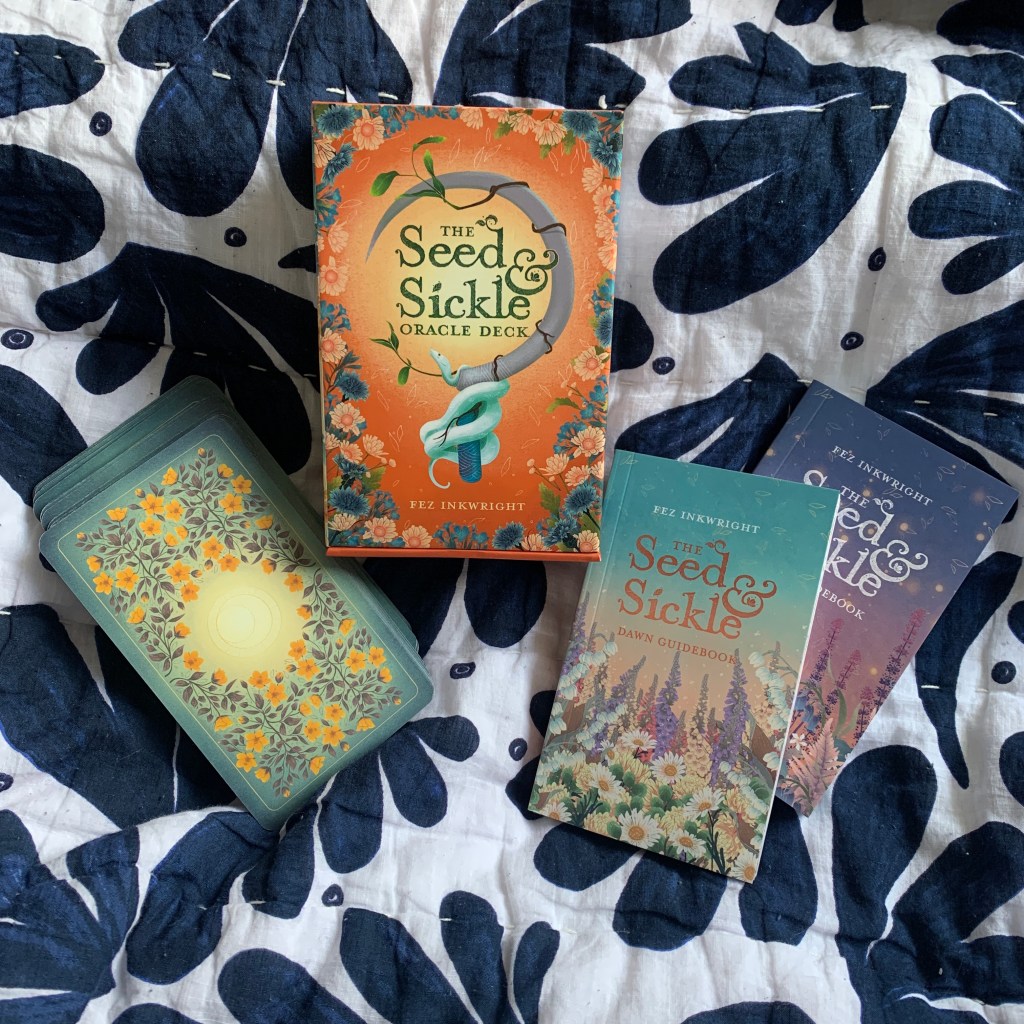
The deck and the guidebooks are packaged in the classic Liminal 11 magnetised cardboard box with slip case, the packaging is both sturdy and beautiful. The deck fits tightly into the sleeve with the two books, and while I can see the benefits in terms of the transport of the deck (it also came with a little cardboard wedge to further decrease movement inside the box), it’s a little too snug for my preference, I can already feel myself catching and bending the edges of the cards and guidebooks as I’m moving them in and out of the box especially now I’ve loosened the bindings of the books with use.
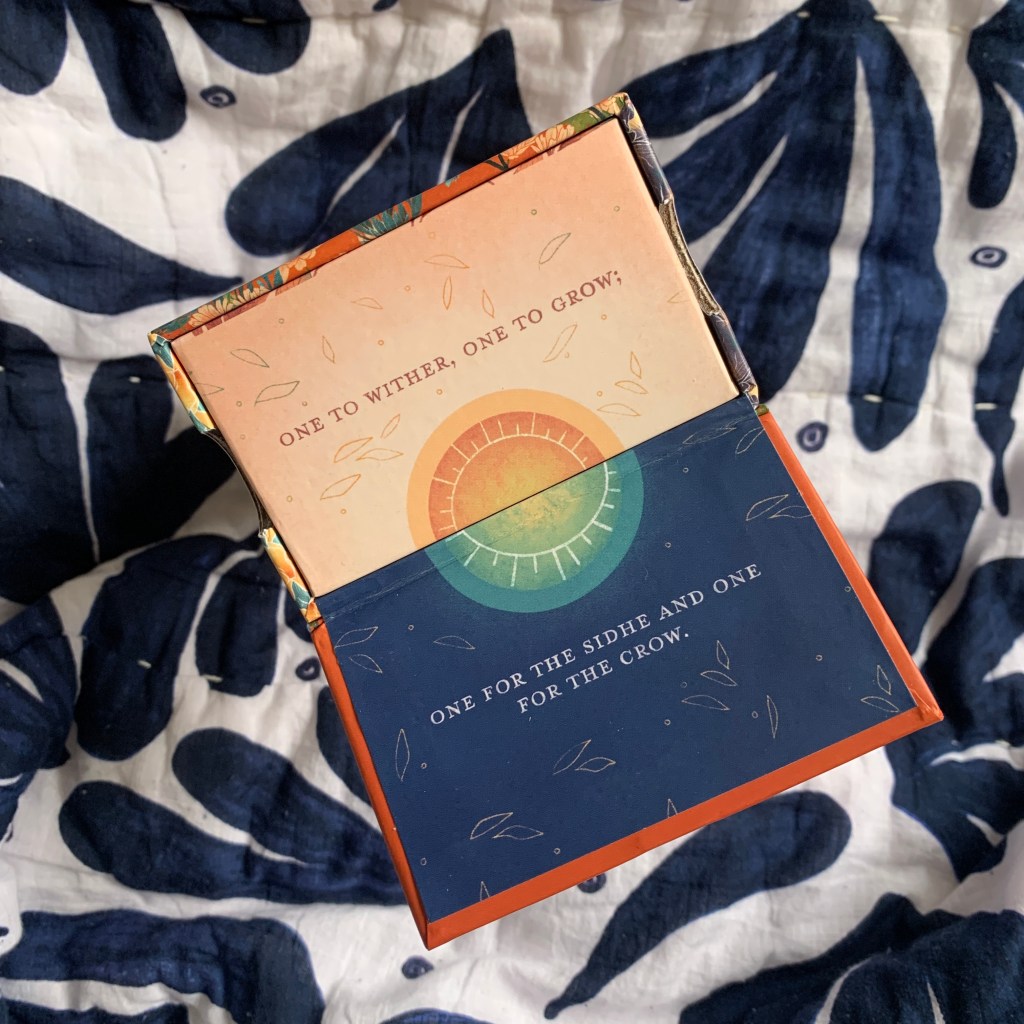
“One to wither, one to grow; one for the sidhe and one for the crow.”
The cards are beautiful, the cardstock is 350gsm with matte machine lamination and while they were a little sticky and the edges were a little sharp to begin with, they now shuffle nicely. The cards are pliable without feeling flimsy but I’m not a riffle shuffler so I can’t speak to their capacity in that regard.
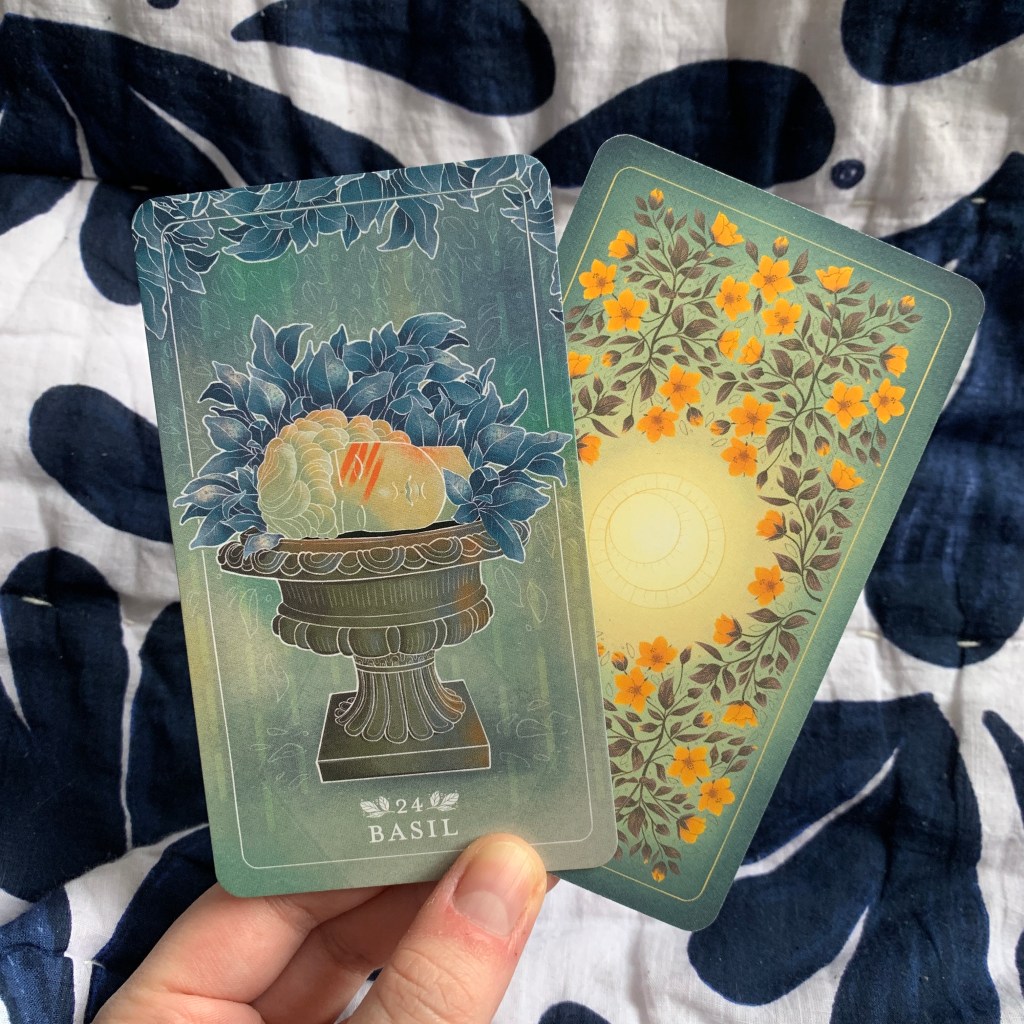
The artwork is beautifully deep and immersive, while managing to be not too busy. The colour palette is largely deep, desaturated jewel tones with some lighter, brighter elements for emphasis. The style is like digitally rendered, dynamic, botanical drawings, it’s hard to fully describe. The card backs are beautiful, a deep teal gradient background with golden flowers of a similar form of those on the Pimpernel card, the backs are subtly non-reversible but given the idea behind the two guidebooks, I can’t see the need to read reversals anyway, the books recommend swapping between guides if you come across a reversed card.
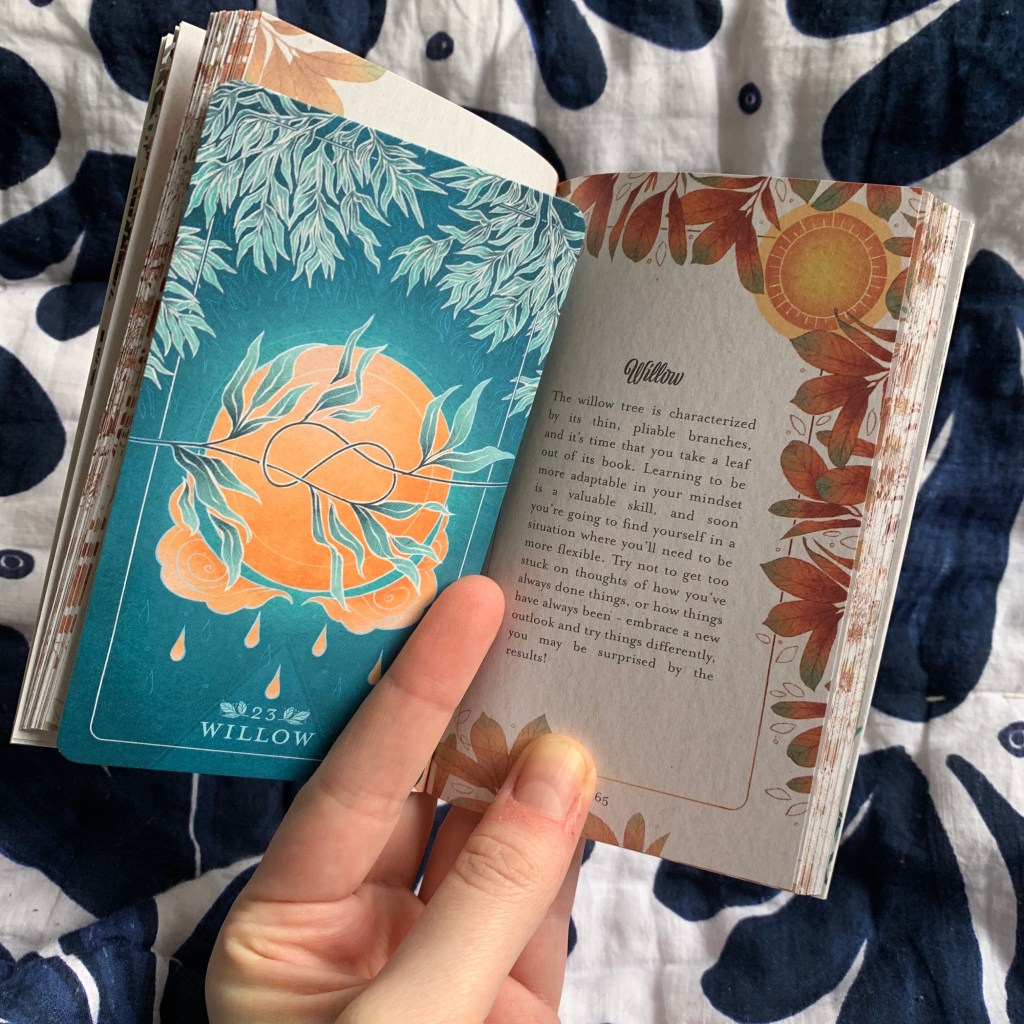
The guidebooks separate the cards into groups by season, Spring is 0-12, Summer is 13-27, Fall is 28-41 and Winter is 42-54, the cards seem to be ordered more by the meanings than growing seasons.
I am by no means an oracle deck aficionado, so working with this deck has been a bit of a learning curve, I’ve needed a fair bit of hand holding and fortunately that has been available in the two guidebooks. One point to mention on the inclusion of the two guides is that other than the Dawn/Dusk meanings and some different spreads, the books repeat much of the same information.
Deck Interview
As usual, I’m using the deck interview spread from Little Red Tarot and using the deck’s accompanying booklets to answer the questions in the deck’s “own words” so to speak. It was a little hard to get clear answers because I didn’t know which guide to follow and wanted to get an idea of both meanings, but they ended up often being a little contradictory so each answer took some thought to figure out.
I’ll denote the Dawn definition with 🌞 and the Dusk with 🌜.
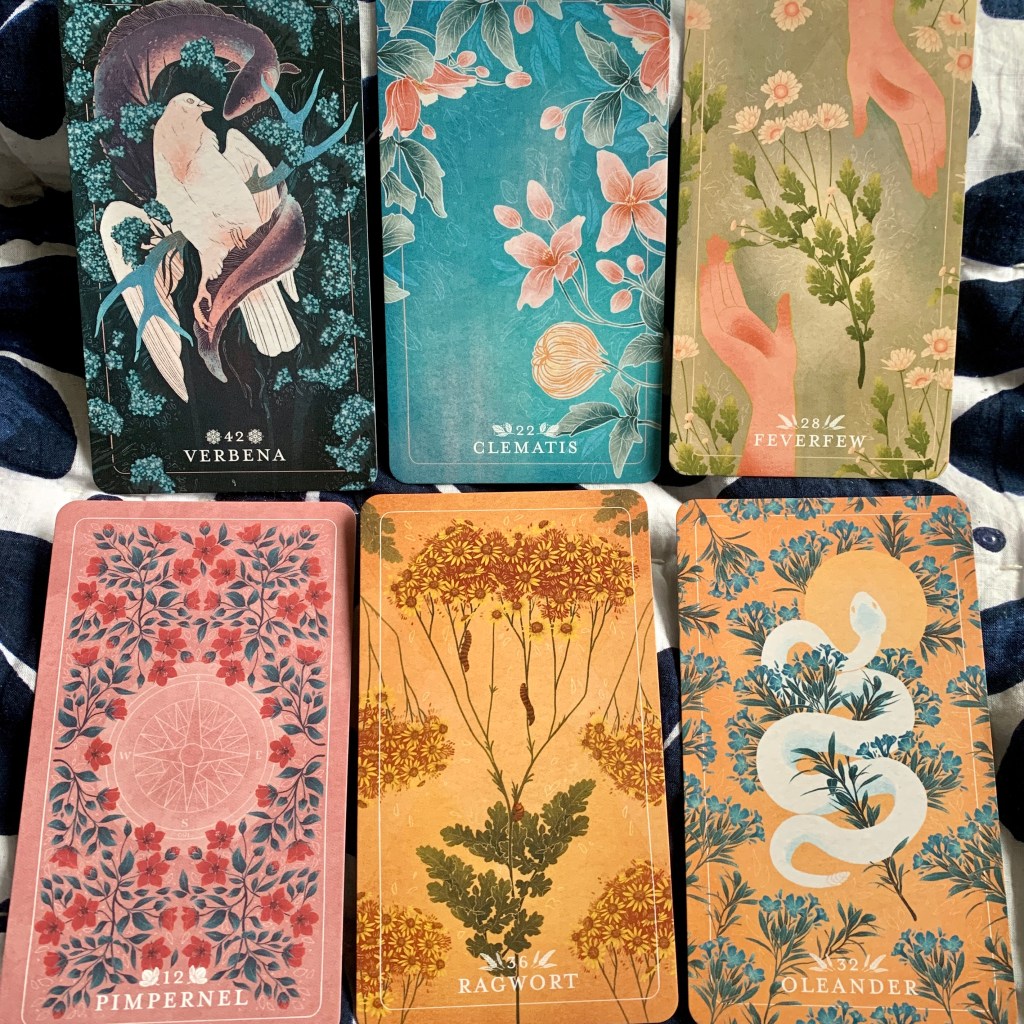
42 Verbena, 22 Clematis, 28 Feverfew, 32 Oleander, 36 Ragwort, 12 Pimpernel.
Tell me about yourself, what is your most important characteristic?
Verbena
🌞: Sincerity, curating new relationships.
🌜: Compromise, reconciliation, stand your ground
This card gives me a sense of balance, which makes sense given the dual nature of this oracle. It also positions itself as a good deck for me to develop my understanding of how an oracle deck can fit into my practice, as a new friend to call on. There’s also a gentleness to this deck, a real focus on the natural rhythms of the world, the cycles of the days and the seasons, highlighting the importance of time for growth and time for rest.
Strengths?
Clematis
🌞: momentum, support, reciprocity, determination
🌜: letting go, trust
The strengths of this deck seem to stem from its holistic view of life. It supports you wherever you are and whatever your question may be, you get to choose whether to take action or take a pause and the cards will have an answer for you.
Limitations?
Feverfew
🌞: protection, bitterness, self preservation, avoidance
🌜: nurturing, supporting others, giving, companionship
I can see that the limitations of a deck like this (for me and my way of working) is that it might end up a little biased, a little too comfortable. Part of the benefits of tarot can be when it tells you what you know deep down but don’t want to hear, I can’t see this deck being so pushy!
What do you need from me?
Oleander
🌞: thinking things through, “pyrrhic victory”, end doesn’t justify the means
🌜: uncertainty, clouded decisions, consider all angles
The best way to work with this deck seems to be to really focus on all the details, to conjure a full world picture of each card and what it means, both through the guides and what each plant means in the reader’s life personally. I can definitely see this deck being an amazing jumping off point for further research around plant allies and their correspondences.
What will the quality of our relationship be?
Ragwort
🌞: uniqueness, appreciation, ugly ducking
🌜: restricted by regrets, in the weeds, wallowing
I think this might be the beginning of something great for my personal practice. As Spring comes round the corner again, my focus has been on developing my knowledge of plants both in the wild and in my own garden, this deck seems to have come into my life at the perfect moment. Its definitely showing me the value of an oracle deck, in terms of my tarot practice but also in terms of personal development and as a tool for study.
 Sapling Tarot
Leave a comment